
Research review by the Worth Buying Canada team · Independent product-research team
Product links inspected October 4, 2026 · Research reviewed October 4, 2026 · How the evidence was assessed
Affiliate disclosure: This page contains affiliate links. We may earn a commission at no additional cost to you.
Best Kids’ Winter Jackets & Parkas in Canada (2026)
Thirteen kids’ winter jackets compared by insulation system, weather protection, coverage, mobility, grow features, snow sealing, care burden and exact-model evidence.
Quick choices
Start here to find a choice that fits your needs. Each card jumps to the full review below, with the comparison table kept directly underneath.
Compare all 13 kids’ winter jackets and parkas
Compare the exact configuration, intended use and main limitation. Published specifications and any named independent tests have different evidence limits; this is a research comparison, not a head-to-head test by Worth Buying Canada.
| Product | Features explained | Who it suits | Before you buy | Where to buy |
|---|---|---|---|---|
 ProductColumbia Youth Boys Nordic Strider II Jacket Best all-around boys’ ski jacketRead the full review ↓ | Features explained Omni-Tech waterproof-breathable shell; critical seam sealing. Omni-Heat reflective lining; 200 g Microtemp XF II insulation. OUTGROWN 1.5-inch sleeve extension; Sherpa-lined adjustable hood. | Who it suits Nordic Strider II combines an insulated waterproof-breathable shell with a sleeve-growth system. It is worth comparing for snow days when both weather protection and fit over layers matter. Sleeve extension does not guarantee the body will fit for another season. Skiing, school and wet snow when weather protection and sleeve-growth room both matter. | Before you buy Only critical seams are sealed, and the shorter ski cut gives less leg coverage than a long parka. | Where to buyView Columbia Nordic Strider II on Amazon.ca |
 ProductHelly Hansen Kids’ Rider 2.0 Insulated Ski Jacket Best independently tested wet-weather ski jacketRead the full review ↓ | Features explained HELLY TECH Performance two-layer shell; 17,000 mm water column. Fully seam sealed; 133 g PrimaLoft Black Eco insulation. Powder skirt; articulated sleeves. Detachable hood. | Who it suits Rider 2.0 is a ski-focused option with an exact-model child field test behind the assessment. Its snow-sport design is relevant for regular ski days, but that test is not a head-to-head comparison proving it outperforms every jacket here. Frequent skiing, wet snow and long active winter days where dependable storm sealing matters. | Before you buy Premium price, shorter alpine cut, and the checked Amazon offer used a third-party seller. | Where to buyView Helly Hansen Rider 2.0 on Amazon.ca |
 ProductThe North Face Boys’ McMurdo Parka Best deep-cold boys’ parkaRead the full review ↓ | Features explained Waterproof DryVent shell; 600-fill recycled down. Long cut; insulated hood. | Who it suits The Boys’ McMurdo combines long coverage, down insulation and a waterproof DryVent outer. Consider it for school, walking and outdoor waits when a parka makes sense. A shorter ski jacket is a different choice for a child who prioritizes freedom of movement on the slopes. School commutes and long periods outdoors. | Before you buy Bulky and warmer than needed for high-output skiing. | Where to buyView on Amazon.ca |
 ProductThe North Face Boys' Warm Antora Rain Jacket Best waterproof mid-warmth everyday jacketRead the full review ↓ | Features explained Seam-sealed waterproof-breathable DryVent 2L shell; non-PFC DWR (water-repellent surface treatment). 60 g Heatseeker insulation in sleeves/lower body; 220 g/m² fleece in hood/upper body. Stormflap; reflective details. | Who it suits Warm Antora combines a waterproof shell with insulation and fleece-lined areas. Compare it for everyday school use in mixed winter weather, while checking the actual layering room rather than assuming the construction guarantees warmth for every child. Wet snow, school, recess and active winter days when weather protection matters more than maximum parka warmth. | Before you buy Insulation is relatively light in the sleeves and lower body, and there is no powder skirt; add layers for low-output deep cold or prolonged resort use. | Where to buyView The North Face Boys' Warm Antora on Amazon.ca |
 ProductColumbia Boys’ Powder Lite II Hooded Best light everyday pufferRead the full review ↓ | Features explained Water-resistant face; recycled synthetic insulation. Omni-Heat; hooded puffer. | Who it suits Powder Lite II is a water-resistant puffer for dry-cold use or layering, not a substitute for a waterproof snow jacket. Choose the simpler design when that weather limitation fits the routine; use the child-restraint guidance above for travel rather than treating a jacket’s low bulk as proof of harness compatibility. Dry cold, school and layering. | Before you buy Not a prolonged-wet-snow shell. | Where to buyView on Amazon.ca |
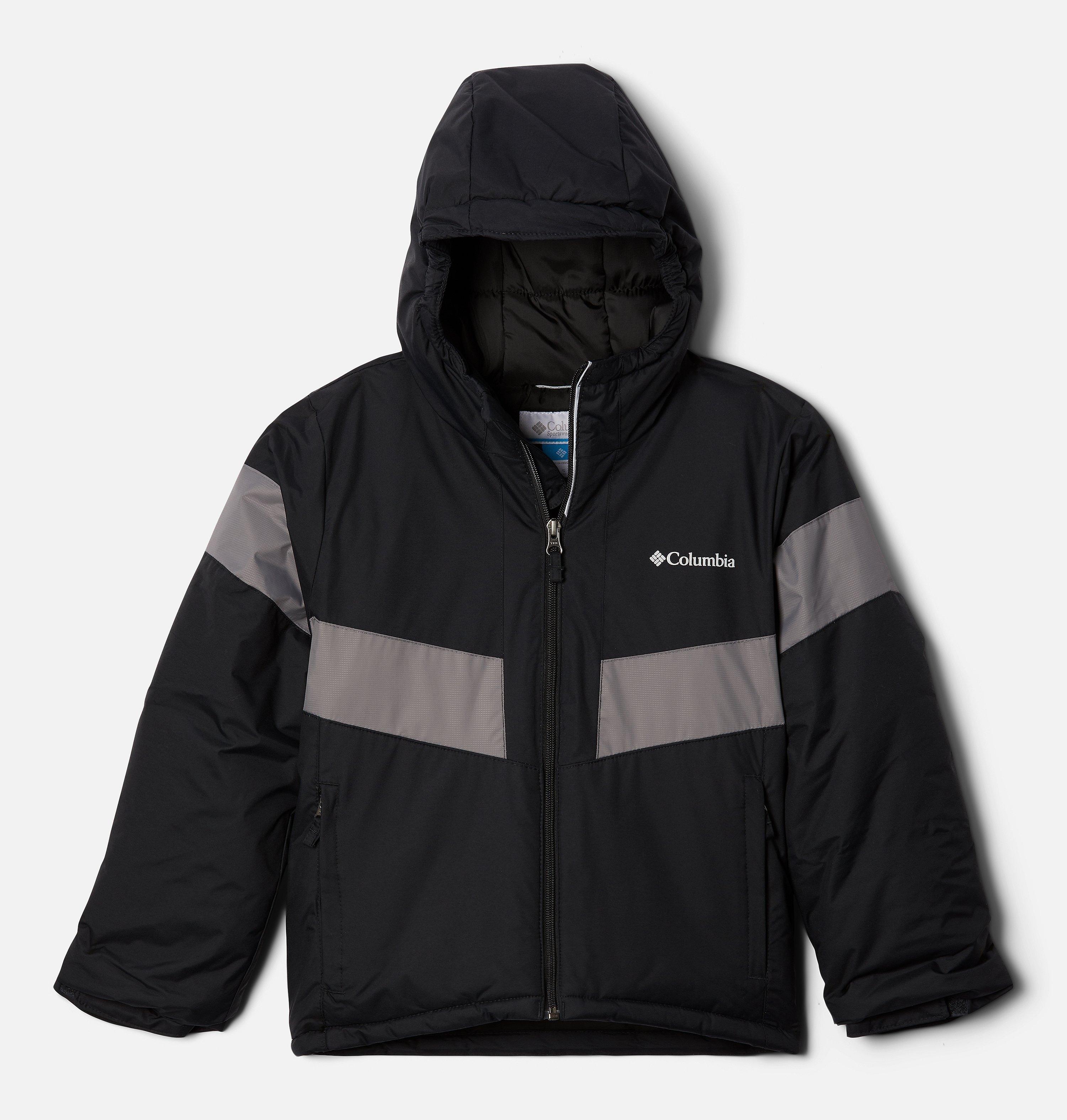 ProductColumbia Boys’ Lightning Lift II Best value snow jacket with waterproof fabricRead the full review ↓ | Features explained Waterproof fabric without seam sealing or a membrane; 240 g/m² synthetic insulation. Adjustable hood and cuffs. | Who it suits Lightning Lift II is a snow-ready choice for families that want an insulated jacket without the length of a parka. Columbia specifies waterproof fabric without seam sealing or a membrane, plus 240 g/m² insulation and an adjustable hood and cuffs; those features suit active school days and ordinary snow play, but not prolonged wet exposure. Skiing, school and active snow play. | Before you buy Unsealed seams limit sustained wet-weather protection; add layers for low-output cold. | Where to buyView on Amazon.ca |
 ProductColumbia Kids’ Arctic Blast II Best adjustable all-weather jacketRead the full review ↓ | Features explained Waterproof winter shell; recycled synthetic insulation. Adjustable hood/cuffs; snow features. | Who it suits Arctic Blast II adds a powder skirt and an adjustable hood to an insulated jacket with waterproof fabric. Its cuffs are elastic, not strap-adjustable. Compare it for snow play, while keeping the distinction between waterproof fabric and a fully seam-sealed garment clear. Long snow days and changing fit needs. | Before you buy Adjustment only helps when cuffs/hood/hem are set correctly. | Where to buyView on Amazon.ca |
 ProductColumbia Boys’ Mighty Mogul III Best updated technical ski jacketRead the full review ↓ | Features explained Waterproof-breathable critically seam-sealed shell; synthetic insulation. Ski features; adjustable fit. | Who it suits Mighty Mogul III is a ski-oriented insulated jacket with critical seam sealing and snow-sport features. Compare it for resort use rather than long parka-style coverage; critical seam sealing is not the same as fully taped seams. Frequent junior skiing. | Before you buy Critical seam sealing is less comprehensive than fully taped construction. | Where to buyView on Amazon.ca |
 ProductColumbia Girls’ Whirlibird III Interchange Best 3-in-1Read the full review ↓ | Features explained Waterproof shell; removable insulated liner. Omni-Heat; interchangeable layers. | Who it suits Whirlibird III offers three ways to wear the shell and removable insulated liner. That flexibility is useful if both layers will get separate use. If the child will always wear them together, a fixed insulated jacket avoids the extra attachment points and dressing steps. Variable weather and shoulder-season-to-winter use. | Before you buy Two pieces add bulk and can be separated or misplaced. | Where to buyView on Amazon.ca |
 Model photo may show a different colour; select the exact colour and size on Columbia Canada.ProductColumbia Boys’ Winter Powder III Quilted Best warm quilted ski styleRead the full review ↓ | Features explained Thermal-reflective lining; synthetic insulation. Quilted construction; ski hood/pockets. | Who it suits Winter Powder III Quilted combines built-in synthetic insulation with ski-oriented features. Consider it when the child wants that arrangement rather than a removable liner. Its fabric claim should not be read as proof of fully seam-sealed protection. Cold school and resort days. | Before you buy Quilting creates stitched zones and is less weather-oriented than a seam-sealed shell; check size, colour and stock before ordering. | Where to buyView exact model at manufacturer |
 ProductColumbia Kids’ Puffect Hooded Best unisex dry-cold pufferRead the full review ↓ | Features explained Recycled Thermarator synthetic insulation; attached hood. Elastic cuffs; zippered hand pockets. | Who it suits Puffect Hooded is a straightforward unisex puffer for cold, dry days, with recycled synthetic insulation, a hood, elastic cuffs and zippered hand pockets. Columbia does not publish a waterproof-shell claim for this model, so it should not be treated as one-jacket storm protection. Dry cold and casual school use. | Before you buy Not a fully waterproof ski shell. | Where to buyView on Amazon.ca |
 ProductColumbia Boys’ Whirlibird III Interchange Jacket Changeable weather and school-to-ski layeringRead the full review ↓ | Features explained Omni-Tech waterproof/breathable shell; critically sealed seams. Omni-Heat reflective liner; zip-in 3-point Interchange system. OUTGROWN grow system. | Who it suits The Boys’ Whirlibird III lets the child wear the shell and insulated liner together or separately. It makes sense when those separate configurations will genuinely be used. Check that the child can manage the attachments and zips; fixed insulation is simpler if the layers will never be separated. Changeable weather and school-to-ski layering. | Before you buy Critically sealed seams; added liner bulk and zips. | Where to buyView on Amazon.ca |
 ProductColumbia Boys’ Pike Lake II Hooded Jacket Dry-cold school days and everyday outingsRead the full review ↓ | Features explained Omni-Heat reflective lining; Thermarator synthetic insulation. Recycled polyester insulation; adjustable hood and cuffs. Machine washable. | Who it suits Pike Lake II is an insulated, hooded option for dry-cold school routines. It is not a waterproof shell. Compare its fit and everyday features with the other puffers rather than choosing it simply because it is a newer model. Dry-cold school days and everyday outings. | Before you buy Add a waterproof shell for sustained rain or wet snow. | Where to buyView on Amazon.ca |
WINTER BUYING GUIDE • CANADA
How to compare a child’s winter jacket technically
A child’s jacket has to balance warmth with movement and moisture management. Long parkas reduce exposed area during low-output school commutes and waiting; shorter ski jackets improve leg mobility and often add powder skirts, pass pockets and sleeve-growth systems. Waterproof shell construction matters more during wet snow and repeated playground contact than it does during short dry-cold trips.
Insulation labels are not directly interchangeable. Down fill power describes loft quality, not total down quantity. Synthetic insulation may be published in grams per square metre, but the same number can feel different depending on where insulation is placed, garment area, lining, shell and fit. We therefore do not turn 600-fill down, 150 g synthetic and a reflective lining into a fake temperature ranking.
Growth room has a performance limit. A slightly roomy jacket allows midlayers and growth, but an excessively large hood, cuffs or torso can increase air exchange and make snow sealing worse. Sleeve-extension systems can extend useful arm length; they do not make the torso, hood or insulation grow. Fit should therefore be checked with the child’s normal base/midlayer system.
Evidence note: Adult clothing-temperature standards cannot simply be converted into child temperature guarantees. Activity, wind, wetness, age, fit and layering vary too much. We use published construction and exact-model evidence to explain fit-for-use rather than inventing a “good to -30°C” number.
Detailed technical recommendations
Pick 1
1. Helly Hansen Kids’ Rider 2.0 Insulated Ski Jacket
Quick verdict: Rider 2.0 is a ski-focused option with an exact-model child field test behind the assessment. Its snow-sport design is relevant for regular ski days, but that test is not a head-to-head comparison proving it outperforms every jacket here.
Construction: Helly Hansen specifies a HELLY TECH Performance two-layer shell, 17,000 mm water column, full seam sealing, 133 g PrimaLoft Black Eco insulation, an adjustable powder skirt, articulated sleeves, detachable hood, ski-pass pocket and reflective/high-visibility details.
Fit is not uniformly forgiving. Other parents found it small, and one replaced it because the tight, rough cuffs and bunched-up fit bothered their child.
Availability note: The previously checked Amazon offer was sold by a third party. Recheck the seller, size and stock before ordering.
Independent evidence: Outside’s syndicated 2023 kids’ winter-gear report names the Rider 2.0 jacket and describes a dry four-hour ski day with repeated falls, warmth in windy 20°F runs, and protection during prolonged 40°F rain play. It verifies the named 2.0 generation, though it does not print Helly Hansen style 41773; the official product page identifies that style.
Fit and Canadian use: The shorter articulated cut and powder skirt favour skiing and active snow play over low-output school commuting. Confirm sleeve reach, hood movement and the seal over mittens with the child’s normal layers.
Main limitation: The alpine cut gives less leg coverage than a parka. Verify the exact size and seller before ordering; older stock observations should not be treated as present availability.
Sources: Helly Hansen Canada model 41773 specifications and the exact Amazon.ca listing. Independent exact-model test source: Outside, “The Best Kids’ Winter Gear.”
Pick 2
2. The North Face Boys’ McMurdo Parka
Quick verdict: The Boys’ McMurdo combines long coverage, down insulation and a waterproof DryVent outer. Consider it for school, walking and outdoor waits when a parka makes sense. A shorter ski jacket is a different choice for a child who prioritizes freedom of movement on the slopes.
Published specifications in context: The North Face lists 600-fill recycled down in the body, synthetic insulation in the hood and a waterproof, seam-sealed DryVent shell. Fill power describes down loft, not a guaranteed temperature limit; the long cut and shell are the more useful clues for a child waiting or walking outdoors.
Warmth and insulation: The 600-fill recycled down describes loft quality, not the total amount of down in the garment. Because the reviewed Canadian product information does not publish total fill weight, we do not convert the 600-fill label into a temperature rating. The practical advantage comes from combining lofty insulation with a long cut and insulated hood that reduce exposed body area during low-output use.
Weather protection and snow sealing: DryVent waterproof construction gives the McMurdo a more complete weather barrier than a simple water-resistant puffer. That matters in Canadian school use where snow can become wet at sidewalks, playgrounds and bus stops. Keeping the down system protected from moisture also helps preserve the loft that provides insulation.
Fit, mobility and growth: The parka-length cut improves coverage around the hips and upper legs but adds bulk compared with a ski jacket. A child should still be able to raise the arms, sit comfortably and close the jacket over normal school layers without the hood or cuffs becoming excessively oversized. Buying too large for growth can weaken weather sealing around the wrists, neck and hem.
Fit and comfort are praised, but the accounts give little detail about washing, zipper wear or how long individual coats have lasted. An intention to buy again is not a durability history.
Independent evidence: No qualifying independent exact-model child-specific test was confirmed.
Choose it over: Powder Lite II when a waterproof shell and longer coverage matter more than low bulk. Skip it if: the child mainly needs a shorter, freer-moving jacket for active skiing.
Ownership and care: Have the child sit, reach overhead and wear a backpack with the usual school layers before settling on a size. Follow the sewn-in care label for the down-filled body and dry the parka fully after wet use before storing it.
Product and source links: SportChek
Pick 3
3. Columbia Youth Boys Nordic Strider II Jacket
Quick verdict: Nordic Strider II combines an insulated waterproof-breathable shell with a sleeve-growth system. It is worth comparing for snow days when both weather protection and fit over layers matter. Sleeve extension does not guarantee the body will fit for another season.
Construction: Columbia specifies an Omni-Tech waterproof-breathable shell with critical seam sealing, Omni-Heat thermal-reflective lining, 200 g Microtemp XF II insulation, an OUTGROWN system that adds 1.5 inches at the sleeves, an attached adjustable Sherpa-lined hood, adjustable cuffs and a drop-tail hem.
Independent evidence: No qualifying independent exact-model test was confirmed.
Fit and Canadian use: This is a practical ski, school and wet-snow jacket. Leave space for a base and midlayer, but do not oversize so far that cuffs and hood cannot seal effectively.
Main limitation: Columbia specifies critical rather than full seam sealing, and a ski-length cut provides less lower-body coverage than a long parka.
Sources: Columbia Nordic Strider II specifications and the exact Amazon.ca listing.
Pick 4
4. The North Face Boys' Warm Antora Rain Jacket
Quick verdict: Warm Antora combines a waterproof shell with insulation and fleece-lined areas. Compare it for everyday school use in mixed winter weather, while checking the actual layering room rather than assuming the construction guarantees warmth for every child.
Construction: The North Face specifies a waterproof-breathable, seam-sealed DryVent 2L shell with non-PFC DWR, 60 g Heatseeker insulation in the sleeves and lower body, 220 g/m² high-pile fleece in the hood and upper body, an attached three-piece hood, stormflap, zip hand pockets, elastic cuffs and reflective sleeve details.
Independent evidence: No qualifying independent exact-model test was confirmed.
Fit and Canadian use: This works best for wet snow, school, recess and active winter days. Use a warm midlayer in deeper cold, especially for low-output waiting or long chairlift exposure.
Main limitation: The 60 g insulation in the sleeves and lower body is relatively light, and the jacket has no powder skirt. It is not a maximum-warmth parka.
Sources: The North Face model NF0A873S specifications and the exact Amazon.ca listing.
Pick 5
5. Columbia Girls’ Whirlibird III Interchange
Quick verdict: Whirlibird III offers three ways to wear the shell and removable insulated liner. That flexibility is useful if both layers will get separate use. If the child will always wear them together, a fixed insulated jacket avoids the extra attachment points and dressing steps.
Published specifications in context: Columbia describes a critically seam-sealed Omni-Tech outer and a zip-in insulated liner with Omni-Heat reflective lining. The shell, liner and combined jacket serve different weather roles; warmth depends on which configuration the child actually wears.
Warmth and insulation: The removable insulated liner provides the thermal layer while the Omni-Heat component supplements heat retention. Because insulation performance changes when the liner is worn alone versus under the shell, a single temperature claim would be misleading. The real advantage is adjustable system warmth rather than maximum insulation in one fixed garment.
Weather protection and snow sealing: The waterproof outer is the key reason this works as a four-season-style system rather than simply a reversible jacket. The shell can handle wet precipitation while the liner manages insulation, letting the two jobs be separated when temperatures are milder.
Fit, mobility and daily complexity: A 3-in-1 system uses two garments, extra zippers and more fabric. That can feel bulkier than a single insulated shell and gives families more pieces to dry, store and keep track of. The system is most worthwhile when the shell and liner will genuinely be used separately during the year.
Fit is the clearest caution. One parent found the smaller size tight around a lean child’s waist, while the next size was much too large. That makes a try-on with layers worthwhile.
Confidence is Limited: the accounts are promotional and mostly describe fit or early impressions, rather than several seasons of weather protection and wear.
Independent evidence: No qualifying exact-model independent test was confirmed.
Choose it over: a fixed insulated ski jacket when three wearing configurations would replace separate outerwear. Skip it if: the child dislikes two-layer bulk or the family already owns a rain shell and warm midlayer.
Ownership and care: Check the fit with the liner zipped in and with a base layer underneath; cuffs and hood should still close comfortably. Keep track of both pieces, dry them separately after wet days and follow each garment’s care label.
Product and source links: SportChek
Pick 6
6. Columbia Boys’ Powder Lite II Hooded
Quick verdict: Powder Lite II is a water-resistant puffer for dry-cold use or layering, not a substitute for a waterproof snow jacket. Choose the simpler design when that weather limitation fits the routine; use the child-restraint guidance above for travel rather than treating a jacket’s low bulk as proof of harness compatibility.
Published specifications in context: Columbia specifies recycled synthetic Thermarator insulation, Omni-Heat reflective lining and water-resistant fabric. Those features support lightweight insulation in mildly wet conditions, not the sustained precipitation protection of a seam-sealed shell.
Warmth and insulation: Recycled synthetic insulation and Omni-Heat create an insulation-first system without the care demands of down. Because the reviewed listing does not provide a standardized child temperature limit, warmth should be judged by activity, layers and weather rather than a single marketing number.
Weather protection: The outer is water-resistant rather than a fully waterproof seam-sealed shell. That is adequate for brief snowfall and ordinary commuting but is a real limitation for prolonged wet-snow contact, repeated playground falls or long days in freezing rain and slush.
Fit and mobility: Check arm reach with the usual midlayer and, if intended, a separate shell. Leave room without compressing the insulation. For child restraints, follow the restraint manufacturer’s clothing and harness instructions; this review does not establish that the jacket is safe beneath a harness.
Independent evidence: No qualifying exact-model independent test was confirmed.
Choose it over: a heavier ski shell when easy movement and everyday dry-cold comfort are the priority. Skip it if: this must be the child’s only jacket for long, wet snow days.
Ownership and care: Check that the hood and hem can be adjusted over the child’s usual layers. Columbia lists machine washing and tumble drying for this model; follow the garment label and allow it to dry fully before packing it away.
Product and source links: Amazon.ca product page
Pick 7
7. Columbia Boys’ Lightning Lift II
Quick verdict: Lightning Lift II is a snow-ready choice for families that want an insulated jacket without the length of a parka. Columbia specifies waterproof fabric without seam sealing or a membrane, plus 240 g/m² insulation and an adjustable hood and cuffs; those features suit active school days and ordinary snow play, but not prolonged wet exposure.
Published specifications in context: Columbia specifies 240 g/m² insulation, waterproof fabric without seam sealing or a membrane, an adjustable hood and adjustable cuffs. That is useful snow-day equipment, but it is not the same protection as a seam-sealed waterproof-breathable shell.
Warmth and insulation: Columbia lists 240 g/m² synthetic insulation. That is a construction specification, not a temperature rating. Assess layering room for the child’s activity and conditions rather than prescribing one base layer for every outing.
Weather protection and snow sealing: The fabric is described as waterproof, but Columbia explicitly says this model has no seam sealing or membrane. The adjustable hood and cuffs can reduce openings to wind and snow; they do not make the garment equivalent to a seam-sealed shell.
Fit and layering: Try the jacket with the child’s usual cold-day midlayer. The torso should allow arm movement without compressing the layers, while the adjustable cuffs and hood should sit securely rather than leaving wide gaps.
Canadian-use fit: Best for mixed school use and active play in ordinary snow, with a midlayer for colder low-output time. For sustained rain, slush or repeated wet-snow contact, favour a jacket whose seams are sealed.
Independent evidence: No qualifying exact-model independent test was confirmed.
Choose it over: Powder Lite II when a more snow-oriented outer and adjustable openings matter more than puffer-like simplicity. Skip it if: the child needs verified seam-sealed protection for prolonged wet conditions.
Ownership and care: Try it with the fleece the child will wear on colder days, then adjust the hood and cuffs without restricting movement. Columbia lists an OUTGROWN sleeve-extension system; use it only as directed and follow the garment’s care label.
Product and source links: Amazon.ca product page
Pick 8
8. Columbia Kids’ Arctic Blast II
Quick verdict: Arctic Blast II adds a powder skirt and an adjustable hood to an insulated jacket with waterproof fabric. Its cuffs are elastic, not strap-adjustable. Compare it for snow play, while keeping the distinction between waterproof fabric and a fully seam-sealed garment clear.
Published specifications in context: Columbia lists recycled Thermarator insulation, waterproof fabric, an adjustable hood, elastic cuffs and an attached powder skirt. The distinction from a casual puffer is the combination of insulated coverage and snow-specific openings, not a published temperature guarantee.
Warmth and insulation: Recycled synthetic insulation is practical for children because it is less sensitive than down to incidental moisture and repeated drying cycles. The published construction supports a properly insulated winter-jacket use case, but it does not provide enough standardized information to justify a precise temperature limit.
Weather protection: Columbia identifies waterproof fabric, but that alone does not establish fully sealed seams. The attached powder skirt addresses snow entry at the waist; it does not turn the jacket into a verified all-weather storm shell.
Fit and openings: Adjust the hood with the child’s usual hat, then check that the elastic cuffs overlap their gloves without leaving a gap or restricting reach. Extra sleeve length should not leave hands buried in fabric.
Independent evidence: No qualifying exact-model independent test was confirmed.
Choose it over: a simple water-resistant puffer when snow coverage and adjustability matter. Skip it if: the main need is the longer passive warmth of a parka, or a fully specified seam-sealed storm shell.
Ownership and care: Check arm reach and seated comfort with the usual midlayer. Recheck hood fit and the overlap between elastic cuffs and gloves when accessories change. Follow the sewn-in wash and drying instructions.
Product and source links: Amazon.ca product page
Pick 9
9. Columbia Boys’ Winter Powder III Quilted

Availability note (September 21, 2026): The linked Zing/Black, Small Amazon.ca variation (ASIN B0DK6BS5M4) was purchasable on September 21, 2026, with one unit shown in stock and Amazon.ca listed as both shipper and seller. Other sizes and colours may differ; confirm the selected variation and current availability before ordering.
Quick verdict: Winter Powder III Quilted combines built-in synthetic insulation with ski-oriented features. Consider it when the child wants that arrangement rather than a removable liner. Its fabric claim should not be read as proof of fully seam-sealed protection.
Published specifications in context: Columbia lists Omni-Heat Infinity lining, recycled Thermarator insulation, waterproof fabric, venting and a powder skirt. Its quilted build emphasizes insulated comfort; the published listing does not establish fully seam-sealed construction.
Warmth and insulation: Quilting helps keep synthetic insulation distributed through the garment instead of allowing it to migrate freely. The stitch lines also interrupt the lofted layer, so a visibly puffier jacket should not automatically be assumed warmer than a continuous-shell design. The thermal-reflective lining supplements the insulation but does not replace it.
Weather protection and snow sealing: This design is less weather-oriented than the more explicitly waterproof and seam-sealed ski models in the guide. It can suit ordinary snow and cold conditions, but repeated wet-snow exposure is a reason to favour a jacket with clearer waterproof and seam-sealing specifications.
Fit and mobility: The quilted puffer construction adds more loft and visual bulk than lighter technical shells. Fit should leave enough room for arm movement and a normal base layer without compressing the insulation, while avoiding excessive torso volume that increases air movement around the hem and cuffs.
Canadian-use fit: A cold-school-day and resort option when insulation and ski pockets are useful, but prolonged wet-snow exposure calls for checking seam protection and the selected size or colour. The linked Amazon variation is the Zing/Black Small, so confirm the chosen variation before ordering.
Independent evidence: No qualifying exact-model independent test was confirmed.
Choose it over: a light shell when the child wants more built-in insulation and ski-day storage. Skip it if: fully seam-sealed waterproofing is the deciding requirement.
Ownership and care: Try it over the child’s usual base layer, checking that the quilted torso does not pull during arm movement. Set the powder skirt and cuffs before snow play; Columbia lists machine washing and tumble drying, subject to the garment label.
Product and source links: View exact model at manufacturer
Pick 10
10. Columbia Kids’ Puffect Hooded
Quick verdict: Puffect Hooded is a straightforward unisex puffer for cold, dry days, with recycled synthetic insulation, a hood, elastic cuffs and zippered hand pockets. Columbia does not publish a waterproof-shell claim for this model, so it should not be treated as one-jacket storm protection.
Published specifications in context: Columbia lists recycled Thermarator synthetic insulation, an attached hood and elastic cuffs for this model. Its product page positions it for cold, dry winters and does not document a seam-sealed waterproof shell.
Warmth and insulation: Synthetic puffer construction is designed to trap insulating air with relatively low structural complexity. The advantage is easy-care everyday warmth and less moisture sensitivity than natural down; the limitation is that the reviewed information does not provide enough standardized data to assign a reliable child temperature range.
Weather protection: Columbia positions this jacket for cold, dry winters and does not document waterproof construction or seam sealing. For steady rain, slush or repeated wet-snow contact, use a separate roomy waterproof shell rather than assuming this puffer will keep precipitation out.
Fit, mobility and layering: The relatively simple puffer format keeps movement easier than a long parka and can work as an insulation layer under a roomy waterproof shell if the fit allows. Layering is most effective when the puffer is not compressed tightly underneath the outer shell.
Canadian-use fit: Use it for dry-cold school trips, errands and casual play. If wet snow or steady precipitation is likely, bring a roomy waterproof outer layer rather than treating this puffer as a storm shell.
Independent evidence: No qualifying exact-model independent test was confirmed.
Choose it over: a technical ski jacket when simple insulation and everyday comfort are enough. Skip it if: one coat must handle frequent wet-snow play or long periods of precipitation.
Ownership and care: Check that the cuffs meet the gloves and the hood stays put without a tight torso fit. Columbia lists machine washing and tumble drying; follow the garment label and avoid compressing the puffer beneath a too-small shell.
Product and source links: Amazon.ca product page
Pick 11
11. Columbia Boys’ Mighty Mogul III
Quick verdict: Mighty Mogul III is a ski-oriented insulated jacket with critical seam sealing and snow-sport features. Compare it for resort use rather than long parka-style coverage; critical seam sealing is not the same as fully taped seams.
Published specifications in context: Columbia lists an Omni-Tech waterproof-breathable shell with critical seams sealed, Omni-Heat Infinity lining, 150 g/m² insulation, a helmet-compatible hood and a powder skirt. Critical seam sealing protects selected seams, not every seam.
Warmth and insulation: Synthetic insulation provides a practical balance for active winter use because it is easier to manage around moisture than down. The jacket should still be layered according to activity and conditions rather than treated as having a fixed temperature rating, which the reviewed information does not support.
Weather protection and seam sealing: Waterproof-breathable fabric is the main technical foundation. Critical seam sealing protects the principal exposure seams but is not the same as taping every seam in the garment. That distinction matters for families comparing ordinary resort protection with maximum prolonged-storm sealing.
Fit, mobility and adjustability: Ski-specific design favours shoulder and hip movement rather than long passive coverage. Adjustable elements can help tune the fit around layers, gloves and headwear, but the jacket should still fit correctly through the torso rather than being purchased dramatically oversized for growth.
Canadian-use fit: Best aligned with frequent junior skiing and active snow days where the hood, powder skirt and pocket layout earn their place. For mostly low-output school waiting, compare the shorter cut with a longer parka.
Fit needs checking carefully. One parent found the coat long, while another complained that the oversized hood let snow reach the child’s head and neck. A good torso fit does not guarantee a fitting hood.
Independent evidence: No qualifying exact-model independent test was confirmed.
Choose it over: a casual puffer when ski-specific coverage and movement are the priority. Skip it if: the family requires fully taped seams or the child chiefly needs long-cut stationary warmth.
Ownership and care: Try it with the child’s helmet, gloves and midlayer, and adjust the hood and powder skirt without limiting arm movement. Columbia lists an OUTGROWN sleeve-extension system; follow its instructions and the jacket’s care label.
Product and source links: Amazon.ca product page
Pick 12
12. Columbia Boys’ Whirlibird III Interchange Jacket
Quick verdict: The Boys’ Whirlibird III lets the child wear the shell and insulated liner together or separately. It makes sense when those separate configurations will genuinely be used. Check that the child can manage the attachments and zips; fixed insulation is simpler if the layers will never be separated.
Published specifications: Omni-Tech waterproof/breathable shell; critically sealed seams; Omni-Heat reflective liner; zip-in 3-point Interchange system; OUTGROWN grow system.
Canadian-use fit: Wear the shell alone in milder weather, the liner in dry conditions, or both together in winter. The waterproof/breathable outer shell and grow system make this a flexible 3-in-1 option for shifting winter conditions. The listing specifies critical seam sealing, so it should not be described as fully seam sealed. Check sleeve length with both layers fitted and practise operating the extra zips before school use.
Fit and care: Try the jacket with the layers the child normally wears. Follow the care label; the listing states machine washing. No universal temperature rating is established.
Availability checked September 11, 2026: The XX-Small option was in stock when checked. Select the required size and colour to confirm its current availability.
Pick 13
13. Columbia Boys’ Pike Lake II Hooded Jacket
Quick verdict: Pike Lake II is an insulated, hooded option for dry-cold school routines. It is not a waterproof shell. Compare its fit and everyday features with the other puffers rather than choosing it simply because it is a newer model.
Published specifications: Omni-Heat reflective lining; Thermarator synthetic insulation; recycled polyester insulation; adjustable hood and cuffs; machine washable.
Canadian-use fit: This newer hooded Pike Lake II uses Thermarator synthetic insulation and an Omni-Heat reflective lining. Adjustable cuffs and hood help control drafts. It is a practical everyday puffer for dry cold, but the listing does not establish a waterproof storm-shell construction. Use a roomy waterproof layer in sustained wet snow; avoid compressing the insulation under it.
Availability checked September 11, 2026: The Small option was in stock when checked. Select the required size and colour to confirm its current availability.
Canadian kids’ jacket checklist
- Fit with real layers: check chest, sleeve and hood while the child is wearing the base/midlayer normally used at school or skiing.
- Do not deliberately oversize too far: excess cuff, hood and hem space can reduce weather sealing even if it adds theoretical growing room.
- Match activity: long insulated parkas favour lower-output commuting; ski shells favour movement, snow sealing and heat management.
- Wet snow changes the priority: waterproof/seam-sealed shells are more valuable when the child repeatedly kneels, falls or plays in wet snow.
- Check care instructions: down requires full loft restoration after washing; synthetic insulation is often simpler to manage but can still lose loft if overheated or stored compressed.
Bottom line
Choose the clothing system before the brand: Rider 2.0 and the ski-oriented Columbia designs address snow-sport needs; McMurdo offers parka coverage; Whirlibird III provides removable layers; and the water-resistant puffers suit a different weather brief. Try the chosen jacket with the child’s gloves, usual layers and snow pants. No insulation figure replaces that fit check.